If you’ve started researching indoor air quality solutions, you’ve probably run into the same fork in the road every homeowner hits: should you install a whole-house air purifier, or is a portable air purifier enough? Both promise cleaner air. Both use similar filtration technology. But they solve the problem in very different ways — and picking the wrong one means either overspending on coverage you don’t need or under-treating a problem that affects your entire home.
This guide breaks down whole-house air purifiers vs. portable air purifiers in plain terms: how each one works, what they actually cost, how well they perform, and which one makes sense for your household. By the end, you’ll know exactly which direction to take — or whether a combination of both is your best move.
What Is a Whole-House Air Purifier?
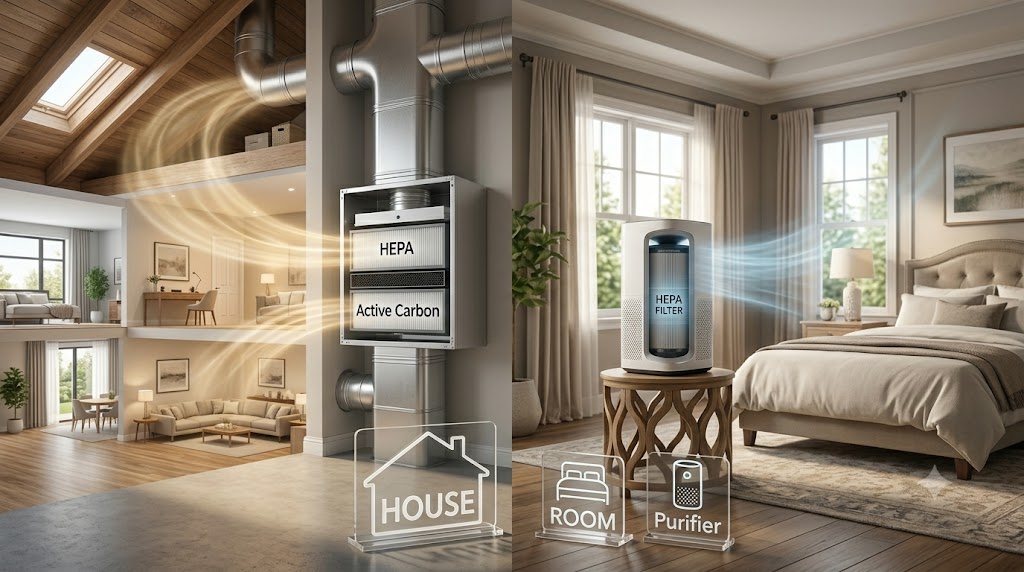
A whole-house air purifier is a home air filtration device that installs directly into your existing HVAC system, usually in the return air ductwork near the furnace or air handler. Instead of cleaning the air in one room, it treats every cubic foot of air that circulates through your ducts — which means every room connected to your HVAC system benefits at the same time.
Most HVAC air purification systems use one or a combination of the following technologies:
- Extended media filters — dense pleated filters rated well above a standard 1-inch furnace filter
- UV-C lamps — germicidal light that targets mold spores, bacteria, and some viruses
- Electronic/electrostatic filters — charge particles so they’re captured more efficiently
- Activated carbon stages — reduce odors and some volatile organic compounds (VOCs)
Because it’s tied into your HVAC system, a whole-house air purifier runs quietly in the background, takes up zero floor space, and requires no daily interaction — but it only cleans air while your system is actively circulating.
What Is a Portable Air Purifier?
A portable air purifier is a standalone, plug-in unit designed to filter the air in a single room or open area. You place it where you need it, turn it on, and it continuously draws in room air, passes it through one or more filters (commonly HEPA and activated carbon), and pushes clean air back out.
Portable units are rated by CADR (Clean Air Delivery Rate), which tells you how large a space the unit can effectively treat — larger rooms need a higher CADR rating. Because they’re self-contained, portable purifiers require no installation, no ductwork, and no HVAC compatibility check. That flexibility is exactly why they’re popular for apartments, rentals, nurseries, and bedrooms.
Whole-House Air Purifiers vs. Portable Air Purifiers: Key Differences
| Factor | Whole-House Air Purifier | Portable Air Purifier |
|---|---|---|
| Coverage | Entire home (every room on the HVAC system) | Single room, typically 150–650 sq ft |
| Installation | Professional HVAC installation required | Plug in and go — no installation |
| Upfront cost | Roughly $419–$12,000 (average ~$2,610 installed) | Roughly $50–$800 per unit |
| Operates when | HVAC system is running | Runs continuously, independent of HVAC |
| Maintenance | Filter/UV bulb changes every 6–24 months | Filter changes every 3–8 months per unit |
| Noise | Virtually silent (uses existing ductwork) | Noticeable fan noise, especially on high speed |
| Best for | Whole-home allergy relief, multi-room households, homeowners | Renters, single-room needs, budget-conscious buyers |
| Scaling up | One system covers the whole house | Requires a separate unit per room |
Cost Comparison: Whole-House vs. Portable Air Purifiers
Cost is usually the deciding factor, so let’s be direct about it.
Whole-house air purifiers typically run $419 to $12,000 installed, with most homeowners landing around $2,610 depending on the filtration technology (media filter, UV-C, or electronic), ductwork accessibility, and whether any HVAC modifications are needed. Ongoing costs are low — most media filters last 6 to 12 months, and UV lamps or carbon filters last 12 to 24 months.
Portable air purifiers are far cheaper upfront, starting around $50 to $150 for a basic single-room unit and climbing to $500–$800 for high-performance models with smart features. The catch: if you want whole-home coverage, you’ll need one unit per room, and each has its own filter replacement schedule (typically every 3–8 months) and electricity draw running 24/7.
Here’s the practical math: purifying a 4-bedroom home with portables could mean buying and maintaining 4–5 separate units — which often costs more over 3–5 years than a single whole-house system, once you add up hardware and filters.
Which One Actually Improves Indoor Air Quality More?
This is where the two approaches genuinely differ in performance, not just convenience.
Whole-house systems treat air continuously as it cycles through your HVAC system — but only when the system is running, and only as effectively as your ductwork allows. In homes with older or leaky ducts, unfiltered air can re-enter the airstream after it’s been cleaned, reducing overall efficiency. In tightly sealed, newer homes with good ductwork, whole-house systems perform very well and deliver consistent air quality improvements in every room, including ones you rarely think about, like hallways and closets.
Portable units with a true HEPA filter are certified to capture 99.97% of particles down to 0.3 microns — a very high standard — but only within their rated square footage. A high-CADR portable purifier sized correctly for a bedroom will often out-perform a whole-house system in that specific room, simply because it’s treating a smaller volume of air more intensively.
The EPA’s own guidance is that the most effective indoor air quality strategy combines source control, proper ventilation, and air cleaning — not just one type of purifier. In other words, neither system is a silver bullet on its own.
Whole-House Air Purifier: Pros and Cons
Pros
- Cleans air in every room simultaneously
- No visible equipment or floor space used
- Virtually silent operation
- Lower long-term maintenance versus running multiple portables
- Adds real value to your home
Cons
- Higher upfront cost and requires professional installation
- Only works while the HVAC system is actively running
- Performance depends on the condition of your ductwork
- Not an option for renters or homes without central HVAC
Portable Air Purifier: Pros and Cons
Pros
- Low upfront cost, no installation needed
- Works independently of your HVAC system, 24/7
- Movable — take it with you if you move
- Great for targeted problems (a nursery, a smoker’s household, a pet-heavy bedroom)
Cons
- Limited to one room or open area per unit
- Multiple units needed for whole-home coverage, which adds cost and maintenance
- Audible fan noise, especially at higher speeds
- Takes up floor space and requires an outlet
Which Is Right for Your Home?
- You rent or don’t have central HVAC → Portable is your only real option.
- You have one specific problem area (a bedroom, nursery, or home office) → A properly sized portable unit is the most cost-effective fix.
- Your whole household deals with allergies, asthma, or odor issues in multiple rooms → A whole-house air purifier delivers more consistent, hands-off results.
- You have an older home with leaky ductwork → Consider a whole-house system paired with a professional duct inspection, or lean on portables in your most-used rooms until ductwork is addressed.
- You want the best of both worlds → Many homeowners install a whole-house system for baseline, whole-home filtration, then add a portable unit in a bedroom or nursery for extra, targeted protection.
Can You Use Both?
Yes — and for many households, this combination approach is the smartest indoor air quality solution. A whole-house air purifier handles continuous, background filtration for the entire home, while a portable unit adds concentrated protection in the one or two rooms where it matters most, like a bedroom for someone with allergies or a home office near a busy street. You get comprehensive coverage without paying for more whole-house capacity than you need, and without cluttering every room with a standalone unit.
Get a Professional Indoor Air Quality Assessment
Choosing between a whole-house air purifier and a portable unit ultimately comes down to your home’s layout, your HVAC system’s condition, and what’s actually driving your air quality concerns — dust, allergens, odors, or something else. A quick DIY answer online can’t account for your ductwork condition or your home’s square footage the way an in-home assessment can.
Precise Air Systems can evaluate your current HVAC setup, test your indoor air quality, and recommend the right-sized solution — whether that’s a whole-house air purification system, a targeted portable setup, or both. [Schedule your indoor air quality assessment today.]
Frequently Asked Questions
Do whole-house air purifiers really work?
Yes, when properly sized and installed in a home with reasonably sealed ductwork. They continuously filter air throughout every room connected to the HVAC system, though performance depends on how often your system runs and the condition of your ducts.
Are portable air purifiers as good as whole-house systems?
Within their rated room size, a quality portable air purifier can perform as well as or better than a whole-house system in that specific space. They simply can’t cover multiple rooms the way a whole-house system does without buying additional units.
How much does a whole-house air purifier cost to install?
Most homeowners spend between $419 and $12,000, with an average installed cost around $2,610, depending on the filtration technology and your HVAC system’s compatibility.
Can I use a portable air purifier alongside central air conditioning?
Absolutely. Portable units work independently of your HVAC system, so they can run alongside central air or heating without any conflict — many households use both together.
Which is better for allergies and asthma?
For whole-home allergy relief, a whole-house air purifier is generally more effective since it treats every room continuously. For a specific problem area, like a bedroom, a well-sized HEPA portable unit can provide more concentrated relief right where you sleep.