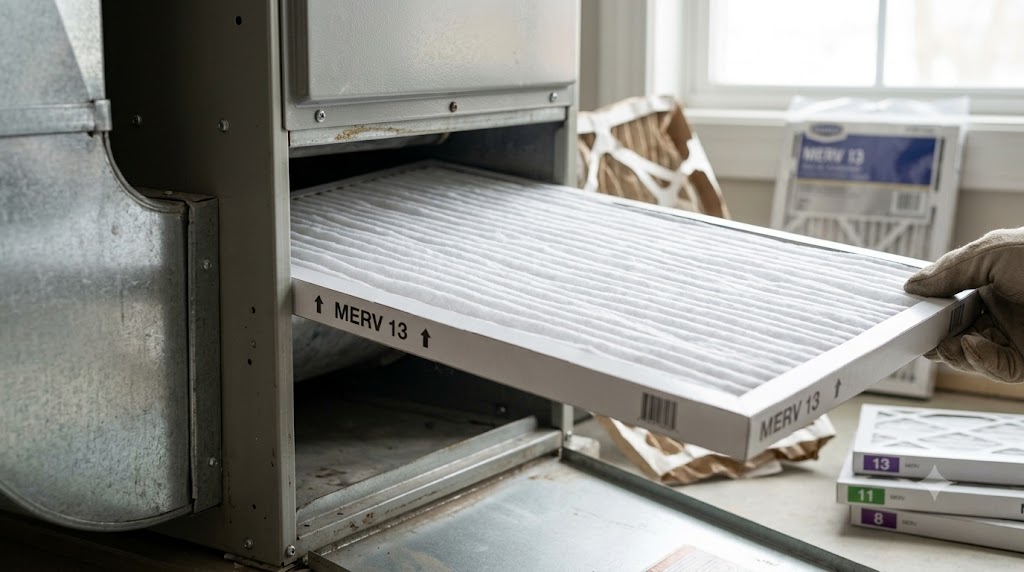
If you’ve ever stood in the filter aisle staring at numbers like MERV 8, MERV 11, and MERV 13 with no idea what any of it means, you’re not alone. Every HVAC filter is rated on the MERV scale, and picking the wrong one can mean two very different problems: either your filter isn’t catching the allergens making you sneeze, or it’s rated so high it’s choking off airflow and straining your system.
This guide breaks down MERV ratings in plain English, compares MERV 11 vs. MERV 13 specifically for allergy sufferers, and tells you exactly which HVAC air filter is right for a Roselle, NJ home — without risking damage to your system.
What Is a MERV Rating?
MERV stands for Minimum Efficiency Reporting Value, a standardized scale developed by ASHRAE (the American Society of Heating, Refrigerating, and Air-Conditioning Engineers) and used industry-wide, including by the EPA. The scale runs from 1 to 16 for residential and commercial filters (with specialty ratings up to 20 for hospital-grade filtration), and it measures how effectively a filter captures particles of different sizes as air passes through it.
The simple rule: the higher the MERV rating, the smaller the particles the filter can trap. But higher isn’t automatically better for your home — a filter rated too high for your HVAC system can restrict airflow, forcing your equipment to work harder and potentially shortening its lifespan.
MERV Rating Chart: What Each Range Actually Filters
| MERV Rating | Captures | Best For |
|---|---|---|
| MERV 1–4 | Large particles only (dust, lint, pollen) | Not recommended — minimal filtration |
| MERV 8 | Dust, standard pollen, dust mites, mold spores (~3 microns and up, ~70% efficiency) | Standard homes, no major allergy concerns |
| MERV 11 | Everything MERV 8 catches, plus pet dander, finer dust, some bacteria (down to ~1 micron) | Homes with pets, mild-to-moderate allergies |
| MERV 13 | Everything MERV 11 catches, plus smoke, smog, virus-carrier particles (down to ~0.3 microns, 90%+ efficiency) | Severe allergies, asthma, immune-compromised households, wildfire smoke exposure |
| MERV 14–16 | Near-HEPA level filtration | Hospitals, labs — rarely needed or appropriate in homes |
MERV 11 vs. MERV 13: Which Is Better for Allergies?
This is the comparison most allergy sufferers actually need to make, since MERV 8 rarely provides enough relief for anyone dealing with regular symptoms.
MERV 11 captures roughly 85% of particles between 3.0–10.0 microns and adds meaningful protection against pet dander, dust mites, and some airborne bacteria that a MERV 8 filter lets through. For most households with pets or mild-to-moderate allergies, MERV 11 hits the sweet spot: noticeably better filtration without significantly restricting airflow in a standard residential system.
MERV 13 captures 90%+ of particles in that same range and, critically, also captures particles down to 0.3 microns — including smoke, smog, and many virus-carrying respiratory droplets. If anyone in your household has asthma, severe allergies, or a compromised immune system, or if you’re regularly exposed to smoke or heavy outdoor pollution, MERV 13 provides real, noticeable improvement.
The tradeoff: MERV 13 creates more airflow resistance (pressure drop) than MERV 11. Some allergy-symptom studies have shown reductions of 60–80% when upgrading from MERV 8 to MERV 11, with further gains at MERV 13 — but only if your system can actually handle it.
Important: Check Your HVAC System Before Upgrading
This is the step most homeowners skip, and it’s the one that actually protects your equipment.
- Standard PSC blower motors (the older, single-speed type found in many residential systems) typically should not exceed MERV 11. Pushing to MERV 13 or higher can restrict airflow enough to freeze the evaporator coil, spike energy bills, and wear out the motor prematurely.
- ECM or variable-speed blower motors (common in systems installed within the last 10 years) can usually handle MERV 13 safely, since they automatically adjust to maintain airflow against the added resistance.
- Your maximum recommended MERV rating is typically listed in your owner’s manual or on a label inside the furnace or air handler cabinet. When in doubt, a licensed HVAC technician can measure your system’s static pressure and confirm what it can safely support.
Never jump straight from MERV 8 to MERV 13 without checking compatibility first. If your system can’t be verified, staying within the MERV 8–11 range and replacing filters more frequently is the safer path.
Choosing the Right Filter for Your Household
- No pets, no allergy concerns, older HVAC system → MERV 8
- Pets in the home, mild-to-moderate allergies, want noticeably cleaner air → MERV 11
- Severe allergies, asthma, immune-compromised household member, smoke exposure → MERV 13 (system compatibility permitting)
- Anything above MERV 14 → Not appropriate for most homes; reserved for hospitals and labs
For Roselle, NJ homeowners specifically, spring tree pollen and fall ragweed seasons often justify at least a MERV 11 filter, while homes near the Turnpike corridor or with a household member managing asthma may benefit from MERV 13 — provided a technician confirms your system can handle it.
How Often Should You Replace Your HVAC Filter?
Replacement frequency depends on the filter’s MERV rating and your household:
- MERV 8: every 60–90 days
- MERV 11: every 60–90 days, or more often with pets
- MERV 13: every 60–90 days — higher-MERV filters trap more particles and can clog faster, so don’t stretch the interval to save money
A dirty, clogged filter — regardless of its MERV rating — performs worse than a clean, lower-rated one and restricts airflow just as much as an incompatible filter would. Regular HVAC air filter replacement matters as much as the rating you choose.
MERV Filters vs. HEPA Air Purifiers: Do You Need Both?
A high-efficiency HVAC filter improves the air across your entire home every time your system runs, but even MERV 13 tops out around 90% efficiency on the smallest particles — well short of a true HEPA filter’s 99.97% capture rate. If allergy symptoms persist even after upgrading your HVAC filter, pairing it with a portable HEPA air purifier in your bedroom or main living space can close that gap. We cover the full comparison in our guides to [the best HEPA air purifiers for home use] and [whole-house vs. portable air purifiers].
Let Precise Air Systems Confirm What Your System Can Handle
Guessing at a MERV rating is how homeowners end up with frozen coils, high energy bills, or filters that aren’t actually helping their allergies. Precise Air Systems serves Roselle, NJ and the surrounding area, and can check your system’s blower motor type, measure static pressure, and recommend the highest-performing filter your HVAC system can safely run — no guesswork required. [Schedule a filter compatibility check today.]
Frequently Asked Questions
What MERV rating is best for allergies?
MERV 11 offers a strong balance of allergy protection and system compatibility for most homes. MERV 13 provides even better protection against smoke, bacteria, and fine particles, but only if your HVAC system’s blower motor can handle the added airflow resistance.
Is MERV 13 too high for a residential HVAC system?
Not necessarily. Systems with ECM or variable-speed blower motors typically handle MERV 13 without issue. Older systems with standard PSC motors often cannot, and forcing a MERV 13 filter into an incompatible system can restrict airflow and damage the equipment.
Can I use a MERV 13 filter if I have asthma?
MERV 13 is often recommended for households managing asthma or severe allergies, since it captures much finer particles than MERV 8 or 11. Confirm your HVAC system supports it first, or consult a technician before upgrading.
How do I know my HVAC system’s maximum MERV rating?
Check your owner’s manual or the label inside your furnace or air handler cabinet. If that information isn’t available, a licensed HVAC technician can measure your system’s static pressure to confirm the highest MERV rating it can safely support.
Do higher MERV filters need to be replaced more often?
Yes, generally. Higher-MERV filters capture more particles, which means they can clog faster than lower-rated filters. Most residential filters, regardless of rating, should be replaced every 60–90 days, or more frequently with pets or heavy household allergen sources.