The air inside your home can be two to five times more polluted than the air outside, according to the EPA — and most of the pollutants responsible are invisible, odorless, and easy to ignore until symptoms show up. If you’ve been dealing with unexplained allergies, headaches, or a musty smell that won’t go away, indoor air quality testing is the first real step toward figuring out what’s actually going on.
This guide walks through every practical way to test your home’s air — from $10 DIY kits to full professional inspections — what each method can and can’t tell you, and how to decide which approach fits your situation.
Signs You Should Test Your Indoor Air Quality
You don’t need a specific reason to test your air, but these signs make it a priority:
- Persistent allergy symptoms, headaches, or fatigue that ease up when you leave the house
- Condensation on windows, musty odors, or visible mold growth
- A recent renovation, new furniture, new carpet, or fresh paint
- Living in an older home with a basement or crawlspace (radon risk)
- Combustion appliances (gas stove, furnace, water heater, fireplace) without a working CO alarm
- You simply want a baseline before investing in an air purifier or HVAC upgrade
DIY Indoor Air Quality Testing Methods
DIY testing is an affordable, accessible starting point, and for several common pollutants it’s genuinely useful — as long as you understand what it can and can’t tell you.
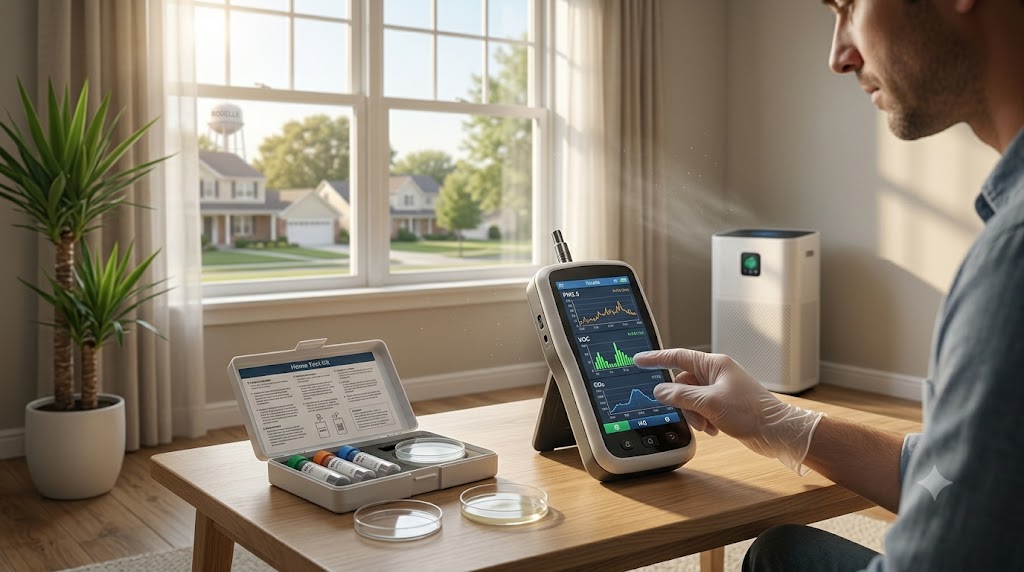
Indoor air quality monitors. A plug-in or battery-powered monitor is the easiest way to get an ongoing read on your home’s air. Most models track some combination of PM2.5, VOCs, CO2, humidity, and temperature, and many sync to an app so you can watch trends over time rather than relying on a single snapshot. We cover specific models in our guide to [the best indoor air quality monitors].
Radon test kits. Short-term charcoal canister kits are widely available, inexpensive, and genuinely useful when used correctly. Place the kit on the lowest livable level of your home (basements are the priority, since radon rises from the ground) for the instructed period — usually 2 to 7 days — then mail it to a lab for results. Radon is measured in picocuries per liter (pCi/L), and the EPA recommends professional mitigation at 4 pCi/L or higher. Because short-term results can be skewed by humidity, temperature swings, or air movement during the test window, a longer test (90+ days) or a second confirmation test gives more reliable results.
Mold test kits. Settling-plate kits (a petri dish left out to see what grows) are the most common DIY option, but they’re also the least reliable — mold spores exist in virtually every indoor and outdoor environment, so a settling plate will almost always grow something. That tells you very little about whether your home has an actual problem. Air-sampling cassette kits that get sent to a lab provide more useful data, but even then, DIY mold testing is best treated as a screening tool, not a diagnosis.
Carbon monoxide alarms. This isn’t a “test” so much as a non-negotiable safety device. Every home with a fuel-burning appliance needs a UL-listed CO alarm installed near sleeping areas — a portable CO meter can supplement this for room-by-room checks, but it should never replace a dedicated alarm.
What DIY Testing Can’t Tell You
Consumer monitors and test kits are genuinely useful as awareness tools — they’ll tell you that VOCs spike after you clean, or that CO2 climbs overnight in a closed bedroom. What they generally can’t do is identify a specific pollutant at a specific concentration with lab-grade precision. A monitor reporting “elevated VOCs,” for example, is reporting a combined total of hundreds of possible compounds — not which one, or where it’s coming from.
When to Call a Professional for Indoor Air Quality Testing
A professional indoor air quality inspection makes sense when:
- DIY test results are unclear, inconsistent, or come back elevated and you need confirmation
- Someone in the household has ongoing, unexplained respiratory symptoms or health effects that improve when they leave home
- You suspect mold, asbestos, lead, or another hazardous material that requires lab-grade sampling
- You need documented results for a home sale, rental, or post-remediation verification
- Radon levels test high on a short-term kit and you need a more precise, defensible reading
A licensed indoor air quality consultant or HVAC professional brings calibrated instruments that go well beyond consumer sensors — often including simultaneous indoor/outdoor sampling (critical for interpreting mold counts correctly), duct inspections, and a written report identifying likely sources and specific fixes, not just a number on a screen.
What Does Professional Testing Cost?
DIY kits typically start around $10–$50 per pollutant. A full professional whole-home indoor air quality inspection generally runs $300 to $1,000, depending on the number of pollutants tested and your home’s square footage. For most households, a reasonable approach is to start with DIY monitoring for everyday awareness, then bring in a professional if results are concerning, symptoms persist, or you’re dealing with a higher-risk pollutant like radon or mold.
How to Interpret Your Results
Once you have numbers, here’s roughly how to read them:
| Pollutant | Concerning Level | Next Step |
|---|---|---|
| Radon | 4 pCi/L or higher | Confirm with a second/long-term test, then contact a radon mitigation professional. |
| CO2 | Consistently above 1,000 ppm indoors | Improve ventilation—open windows, run the HVAC fan, and check for under-ventilated rooms. |
| PM2.5 | Frequent spikes or a “moderate/unhealthy” reading | Run a HEPA air purifier and upgrade your HVAC filter to a higher MERV rating. |
| VOCs/Formaldehyde | Persistent elevated readings without an obvious source | Identify and remove the source; consider professional testing to isolate specific compounds. |
| Humidity | Consistently above 60% | Use a dehumidifier, especially in basements, to reduce mold risk. |
| Carbon monoxide | Any nonzero reading from a dedicated CO alarm | Evacuate immediately and call your gas utility or fire department—this is not a DIY fix. |
Common Indoor Air Pollutants in Roselle, NJ Homes
A few local factors are worth testing for specifically if you’re in the Roselle area: seasonal pollen infiltration during spring and fall, humidity-driven mold risk in basements over the summer, and elevated outdoor particulate matter from proximity to major highways and the Newark industrial corridor working its way indoors through ductwork and open windows. Older homes in the area are also more likely to have leaky ductwork, which lets unfiltered outdoor air bypass your HVAC filtration entirely.
Testing Is the First Step — Not the Fix
Whether your results come from a $15 DIY kit or a full professional inspection, testing only tells you what’s in your air — it doesn’t remove it. Once you know what you’re dealing with, the right next step usually falls into one of three buckets: better filtration (a HEPA purifier or a higher-MERV HVAC filter), better ventilation, or professional remediation for higher-risk issues like radon or mold.
Let Precise Air Systems Handle the Professional Side
If your DIY results are unclear, symptoms persist, or you just want a definitive answer, Precise Air Systems provides professional indoor air quality inspections for homes throughout Roselle, NJ and the surrounding area. We’ll test your air, inspect your HVAC system and ductwork, and give you a clear, actionable plan — not just a number. [Schedule your professional indoor air quality inspection today.]
Frequently Asked Questions
How much does it cost to test indoor air quality?
DIY kits typically run $10–$50 per pollutant. A full professional whole-home inspection generally costs $300–$1,000, depending on the number of pollutants tested and the size of your home.
Are DIY indoor air quality test kits accurate?
They’re useful for screening, especially for radon and basic monitoring of PM2.5, VOCs, and CO2. They’re less reliable for mold (settling-plate kits in particular) and can’t identify specific compounds the way lab-grade professional testing can.
How do I test for radon in my home?
Use a short-term charcoal canister kit placed on the lowest livable level of your home for 2–7 days, then send it to a lab. If results come back at or above 4 pCi/L, the EPA recommends a longer confirmation test and contacting a radon mitigation professional.
What’s the difference between an air quality monitor and professional testing?
A monitor gives you ongoing, real-time trend data using consumer-grade sensors — useful for everyday awareness. Professional testing uses calibrated, often lab-based methods to identify specific pollutants at precise concentrations, which is necessary for health concerns, real estate transactions, or confirming remediation work.
When should I hire a professional instead of testing myself?
If DIY results are inconsistent, if someone in your home has unexplained health symptoms, if you suspect mold, asbestos, or lead, or if you need documented results for a sale or rental, a professional indoor air quality inspection is the right call.