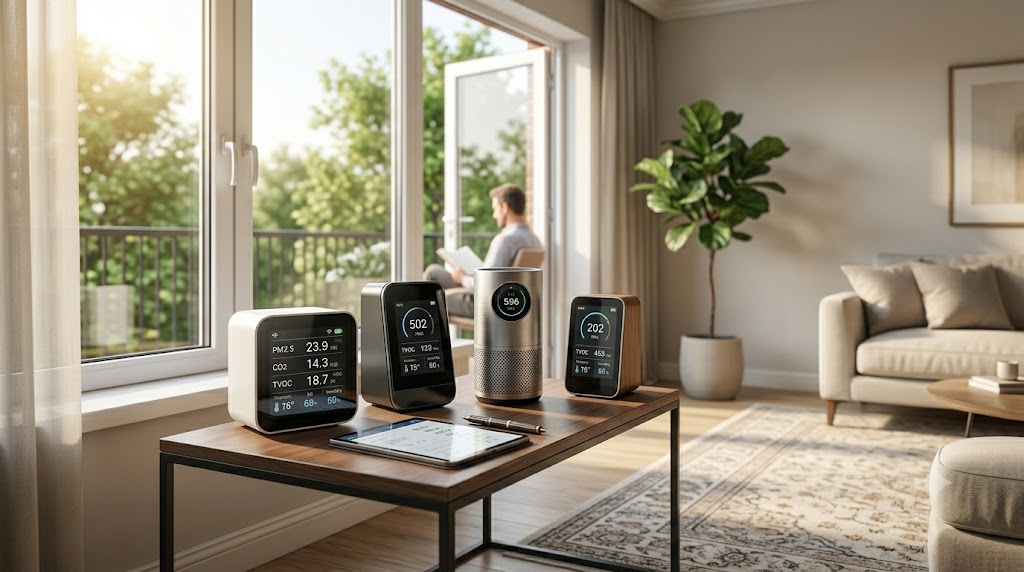
You can’t fix what you can’t measure. That’s the whole case for an indoor air quality monitor: it’s the only way to know whether the air in your Roselle, NJ home is actually clean, or whether you’re breathing elevated CO2, VOCs, or particulate matter without realizing it. Air purifiers and HVAC filters do the cleaning — a monitor tells you if it’s working, and when it isn’t.
This guide breaks down what these devices actually measure, which models perform best in independent testing, and how to use the data to make real decisions about ventilation, filtration, or when to call in a professional.
What Does an Indoor Air Quality Monitor Actually Measure?
Not every monitor tracks the same things, and that’s the first thing to understand before buying one. Most consumer-grade monitors track some combination of:
- PM2.5 / PM10 (particulate matter) — fine dust, smoke, pollen, and soot particles small enough to reach deep into your lungs
- VOCs (volatile organic compounds) — gases released from paint, furniture, cleaning products, and new carpet
- CO2 (carbon dioxide) — a strong proxy for ventilation; rising CO2 means stale air and other pollutants are likely building up too
- Humidity and temperature — key drivers of comfort and mold risk
- Radon — a naturally occurring, odorless radioactive gas responsible for an estimated 21,000 deaths per year in the U.S., and one of the few pollutants that basement-level homes especially need to watch
- Carbon monoxide (CO) — some monitors include a CO reading, but this should never replace a dedicated, certified CO alarm
A good monitor should also respond quickly. Independent testing has shown wide variation here — the best monitors detect a spike in particulate matter within about 30 seconds, while poorly performing models can take several minutes or fail to register a problem at all.
Best Indoor Air Quality Monitors of 2026
Based on current independent testing and expert reviews, here’s how the top models stack up by use case.
Best Overall / Most Comprehensive The Airthings View Plus consistently ranks at the top across multiple independent test panels, largely because it’s one of the only consumer monitors that tracks radon alongside PM2.5, CO2, VOCs, humidity, temperature, and pressure — seven metrics in one device. If you live in an older home or one with a basement, the radon detection alone makes this worth the higher price point (around $330).
Best for Sleep and Concentration Tracking The Awair Element is frequently recommended for bedrooms and home offices thanks to its accurate CO2 sensor, which is the most useful single metric for figuring out whether a room needs better ventilation. It also tracks PM2.5, VOCs, humidity, and temperature in a compact form factor.
Best Budget / Alexa Integration The Amazon Smart Air Quality Monitor is a low-cost, no-screen option that reports readings through the Alexa app and includes a carbon monoxide sensor most competitors skip (though it’s not a substitute for a dedicated CO alarm). It’s a solid entry point if you already use Alexa and want basic monitoring without a big investment.
Best for CO2-Focused Monitoring If your main concern is ventilation rather than full pollutant tracking, the Aranet4 HOME is a favorite among testers for its highly accurate NDIR CO2 sensor, e-ink display, and battery life that can last years on a single set of AA batteries. It skips particulate and VOC tracking to focus entirely on getting CO2, temperature, humidity, and pressure right.
Why Accuracy Matters More Than Feature Count
Here’s the catch with budget indoor air quality monitors: the same pollutant reading can vary by 50% or more between devices, even when they’re sitting in the same room. A monitor with an impressive spec sheet is worthless if its sensors aren’t well calibrated. This is why independent, third-party testing (rather than manufacturer marketing claims) matters so much when comparing models — and why the picks above are weighted toward devices that have actually been tested against reference-grade equipment, not just reviewed on paper.
Where to Place Your Air Quality Monitor
Placement affects what the data actually tells you:
- Kitchen or main living area — captures cooking activity, foot traffic, and daily pollutant sources; the most representative “whole home” baseline
- Bedroom or home office — useful for tracking CO2 buildup overnight or during long work sessions, once you understand your home’s general baseline
- Basement — the most important spot for radon monitoring, since radon accumulates at ground level
- Avoid placing monitors directly next to windows, vents, or an air purifier — all three will skew readings and make the data less useful for everyday decisions
What to Do With the Data
An indoor air quality monitor is only useful if it changes what you do. Here’s how the readings typically translate into action:
- Rising CO2 → Open a window, run your HVAC fan, or check whether your home is under-ventilated for its size
- Elevated VOCs → Identify the source (new furniture, recent painting, cleaning products) and consider a HEPA purifier with an activated carbon stage
- High PM2.5 → Run a HEPA air purifier or upgrade your HVAC filter’s MERV rating — see our guide to [the best HVAC filters for allergies] for details
- Elevated radon → This requires professional mitigation, not just filtration — a monitor’s ongoing radon tracking is a good early warning system, but a short-term radon test kit is the standard for confirming a purchase-decision-level reading
Monitors vs. Lab Testing: Do You Need Both?
Continuous monitors are excellent for tracking trends over time — is your air getting better or worse, and when — but they typically report VOCs as one combined number rather than identifying specific compounds. If you’re chasing down an unexplained odor or a suspected formaldehyde issue, a one-time laboratory air quality test kit can identify individual VOCs and exact concentrations in a way that a continuous monitor can’t. For most households, though, a good continuous monitor covers everyday needs far more usefully than an occasional lab test.
How Precise Air Systems Can Help
An air quality monitor tells you there’s a problem — a Precise Air Systems assessment tells you why, and fixes it. Serving Roselle, NJ and the surrounding area, we can evaluate your HVAC system, test your indoor air quality directly, and recommend the right combination of filtration, purification, and ventilation based on real data from your home, not just a consumer monitor reading. [Schedule your indoor air quality assessment today.]
Frequently Asked Questions
What’s the most important thing an indoor air quality monitor should measure?
It depends on your priority, but CO2 is often the most broadly useful single metric since it’s a reliable indicator of ventilation. For comprehensive coverage, look for a monitor that also tracks PM2.5, VOCs, humidity, and — especially in older or basement-level homes — radon.
Are cheap air quality monitors accurate?
Accuracy varies significantly by brand and sensor type, not strictly by price. Some budget models use well-tested sensors and perform reliably, while others can be off by 50% or more. Look for models that have been independently tested against reference-grade equipment rather than relying on manufacturer specs alone.
Can an air quality monitor detect mold?
Not directly. Most monitors can’t identify mold spores specifically, though elevated humidity readings can indicate conditions favorable for mold growth. If you suspect a mold issue, contact an indoor air quality professional for direct testing.
Do I need a separate carbon monoxide detector if my monitor includes CO?
Yes. Even monitors with a built-in CO reading are not a substitute for a dedicated, certified carbon monoxide alarm, which is designed specifically to meet safety standards for detecting this dangerous, odorless gas.
How do I know if my home needs a whole-house air purifier versus just a monitor?
A monitor tells you there’s a problem; it doesn’t fix it. If your readings consistently show elevated PM2.5, VOCs, or humidity throughout the home rather than in just one room, a whole-house solution is usually more effective than treating individual rooms. Our guide to [whole-house vs. portable air purifiers] breaks down that decision in detail.